Welcome to the Walter H. Capps Center
Greetings from the Walter H. Capps Center!
We are glad to welcome community members, students, staff, and faculty back to campus for the Fall Quarter of 2026. We have a busy and exciting roster of programming and related activities lined up for the year. Let me give you a sense of what is happening this term.
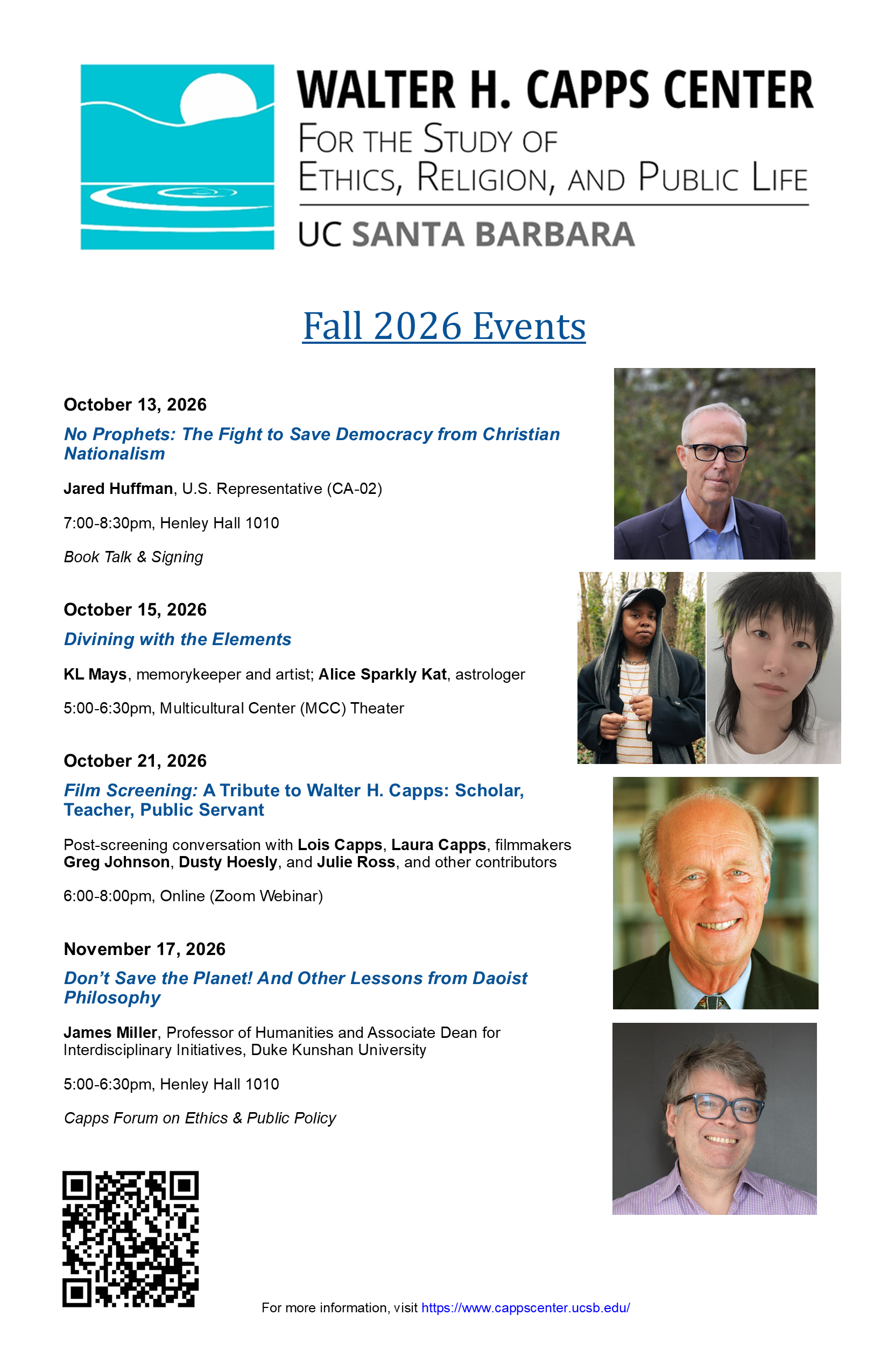
- Our first event of the Fall Quarter will initiate a year-long series on Christian nationalism and democracy, exploring themes that Walter Capps sagely anticipated in his groundbreaking book from 1990, The New Religious Right: Piety, Patriotism, and Politics. On October 13, we will be hosting U.S. Representative Jared Huffman, who will speak about his new book, No Prophets: The Fight to Save Democracy from Christian Nationalism. This event will be followed by related presentations from journalists Michael Blanding (Winter) and Katherine Stewart (Spring).
- On October 15, we are co-sponsoring an event in our collaboration with Professor Joseph Blankholm and his Templeton Foundation project, which focuses on contemporary metaphysical spirituality. Featuring astrologers KL Mays and Alice Sparkly Kat, “Divining with the Elements” promises to be a lively evening at the Multicultural Center.
- On October 21, we are hosting an online premiere screening of a documentary film produced by the Capps Center and Black Diamond Productions, A Tribute to Walter H. Capps: Scholar, Teacher, Public Servant. The screening will be followed by a conversation with contributors to the film, including Lois Capps, Laura Capps, film director Julie Ross, Capps Center Associate Director Dusty Hoesly, and me.
- Our final public event of the term, on November 17, is our annual Capps Forum on Ethics & Pubic Policy focusing on environmental ethics, featuring James Miller (Duke Kunshan University). In “Don’t Save the Planet,” he will address the intersection of Daoism and environmentalism in China.
In addition to our programming, we continue to pursue a number of initiatives that combine community outreach with academic research. Here we would like to share exciting news with you about two of these.
First, this November we are launching our five-year Repatriation Futures project, which is supported by a generous grant from the Henry Luce Foundation. This project centers sustained work with several teams of repatriation practitioners and policy experts from six partner communities near and far: the Santa Ynez Band of Chumash Indians; the Coastal Band of the Chumash Nation; the Bishop Paiute Tribe; the Pawnee Nation of Oklahoma; Hui Iwi Kuamo`o, a Native Hawaiian repatriation organization; and members of the Recover, Restore, and Decolonise (RRaD) team from Nagaland, India. Our collective project will begin in earnest with a workshop in Hilo, Hawai`i, where we will learn from Edward Halealoha Ayau and his team about their ongoing efforts to bring back ancestors and sacred objects. From there, members of our group will head to an international repatriation summit hosted by Return, Reconcile, Renew at Australian National University in Canberra. Stay tuned for more news about this project as it unfolds.
Second, and related to our Repatriation Futures project, we continue to develop our Collaborative Wildfire Science and Planning initiative. A core element of this project has emerged in conjunction with UCSB’s Valentine Natural Reserve in Mammoth and our partners at the Bishop Paiute Tribe. After several years of meetings to assess stakeholder interests and capacity, we and our partners at UC Irvine crafted a co-stewardship agreement for the site. The first of its kind in the UC system, the MOU formalizing this relationship was signed by Chancellor Assanis and adopted by the Bishop Paiute Tribal Council this summer. We are eager to see this project bloom as Paiute citizens reestablish their presence at Valentine.
In addition, we have added many new documents to the Walter H. Capps Archives Online, which features digitized materials from the Walter Capps Papers at the UCSB Library’s Special Research Collections. We have also added new videos to our YouTube channel, including from last spring’s events. You can find other videos of past events on UCTV and UCTV’s YouTube Playlist, or listen to past events via podcast.
Finally, as is true every fall, we are delighted to welcome new cohorts to our three student-focused programs: the McCune Internship Program, the Mendell Graduate Fellowship Program, and the Civic Engagement Scholars Program.
For additional information about the Capps Center, please visit our website and social media.
We’d love to hear from you, and we hope to see you soon!
Sincerely,
Greg Johnson
Director, Walter H. Capps Center